IBPS PO 2026: Probationary Officer Recruitment in 11 Public Sector Banks - Complete Details
I still remember the morning I got my IBPS PO joining letter. It was a Tuesday in November, about fourteen years ago. I'd been checking the IBPS website obsessively for weeks, and then suddenly there it was -- my name on the provisional allotment list, allocated to Canara Bank, posted to a branch in Hubli, Karnataka. I had never been to Karnataka. I didn't speak Kannada. I was a girl from Allahabad who'd studied Hindi medium till 10th standard. And somehow, through an exam I'd taken sitting in a sweaty computer center in Lucknow, my life was about to change entirely.
I'm writing this article because the IBPS PO 2026 notification is out, and I want to talk to you -- not as a journalist reporting facts, but as someone who has lived this journey. I've been a bank officer for over a decade now. I've worked in rural branches where the nearest ATM was 12 kilometers away, and I've worked in city branches where the footfall was 500 customers a day. I've seen young POs join with stars in their eyes and I've seen some struggle. Banking is a wonderful career if you go in with the right expectations. So let me give you those expectations, along with all the technical details you need about this exam.
The Notification: What's Been Announced
The Institute of Banking Personnel Selection has released the Common Recruitment Process notification for Probationary Officers and Management Trainees for 2026. The registration window opened on 25 February 2026 and closes on 18 March 2026. The Preliminary exam is tentatively scheduled for May 2026, the Main exam for July 2026, and interviews for September-October 2026. Provisional allotment of banks is expected by November 2026.
The expected vacancy count this year is somewhere between 4,500 and 5,000 across all 11 participating public sector banks. The exact bank-wise breakdown will be published separately on the IBPS website (ibps.in). Vacancies are distributed according to the government's reservation policy -- Unreserved, SC, ST, OBC (Non-Creamy Layer), EWS, and PwBD quotas all apply.
The Banks: Where Could You End Up?
There are 11 public sector banks in the IBPS PO process. Let me tell you a bit about each one, because where you get posted affects your daily life more than most candidates realize.
Punjab National Bank (PNB) is one of the biggest. After merging with Oriental Bank of Commerce and United Bank of India, it has a massive branch network, particularly strong in North India. If you get PNB, chances are good you'll be posted somewhere in UP, Bihar, Delhi, Rajasthan, or Punjab initially. Huge bank, lots of opportunities, but also massive workloads at busy branches.
Bank of Baroda (BoB) has a strong international presence -- over 20 countries. Domestic network is extensive too, with a concentration in Gujarat, Maharashtra, and Rajasthan. BoB is known for a relatively progressive work culture among PSBs.
Canara Bank, my bank, has its roots in Karnataka. Merged with Syndicate Bank in 2020. Very strong in South India, particularly Karnataka, Kerala, and Tamil Nadu. If you get Canara and you're from the North, be prepared to learn a new language. But also be prepared for some of the best food you've ever eaten -- I say that from personal experience.
Union Bank of India absorbed Andhra Bank and Corporation Bank. Headquartered in Mumbai, with wide reach across Western and Southern India. Indian Bank merged with Allahabad Bank, strong in South India and parts of North India. Bank of India has good presence in Maharashtra and Central India. Central Bank of India, one of the oldest banks, headquartered in Mumbai. Bank of Maharashtra is Pune-based with strong Maharashtra focus. Indian Overseas Bank is Chennai-based with some international branches. Punjab and Sind Bank is relatively smaller, focused on North India. UCO Bank is Kolkata-based with significant Eastern India presence.
Note: SBI has its own separate PO exam. IBPS doesn't recruit for SBI.
Am I Eligible? Let's Check
You need to be an Indian citizen. Age: 20 to 30 years as of 1 August 2026. So if you were born between 2 August 1996 and 1 August 2006, you qualify on age. Relaxations: SC/ST get 5 extra years (up to 35), OBC-NCL gets 3 extra years (up to 33), PwBD gets 10 extra years (up to 40). Ex-servicemen, widows, divorced women, and women judicially separated from husbands get additional relaxation as specified in the notification.
Education: any graduation from a recognized university. BA, B.Sc, B.Com, BBA, BCA, B.Tech, MBBS, LLB -- any degree works. Even distance education and correspondence degrees are accepted as long as the university is UGC-recognized. You need your degree or final year marksheet at the time of applying. If you're waiting for your result, check the notification -- IBPS typically requires the degree to be completed before a cutoff date they specify.
Computer knowledge is expected but not technically an eligibility disqualifier. However, you'll be working on core banking software, using computers all day. If you're not comfortable with computers, start getting comfortable now.
The Three Rounds: Prelims, Mains, Interview
Let me walk you through each stage the way I'd explain it to a young cousin who just asked, "Didi, bank exam kaisa hota hai?"
Round 1: Preliminary Exam
This is a one-hour online test. 100 questions, 100 marks. Three sections, each with a separate timer -- you can't go back to a previous section once the time for it ends. This is different from SSC exams where the whole paper has one timer.
English Language: 30 questions, 30 marks, 20 minutes. Reading comprehension (usually one or two passages with 5-10 questions each), cloze test (a passage with blanks -- you pick the right word), para jumbles (rearrange sentences to form a paragraph), error spotting, fill in the blanks, and sometimes miscellaneous grammar questions. If your English reading is decent, this section is manageable. If it's weak, this is where your preparation needs to start -- months before the exam, not weeks.
Quantitative Aptitude: 35 questions, 35 marks, 20 minutes. Number series (find the pattern and predict the next number), data interpretation (tables, bar graphs, pie charts with 5 questions per set), simplification/approximation, quadratic equations, and arithmetic word problems covering percentages, profit-loss, SI/CI, ratio, time-work, time-speed-distance, probability, permutations. The DI sets in bank exams are calculation-heavy. Speed matters enormously here. You need to calculate fast, not just accurately.
Reasoning Ability: 35 questions, 35 marks, 20 minutes. This is the section bank exams are known for. Seating arrangement puzzles -- linear and circular, sometimes double-layered (e.g., 8 people sitting in a row, facing north or south, with different professions). Syllogisms, inequalities, coding-decoding, blood relations, direction sense, order and ranking. The puzzles can be time-consuming. If you get stuck on one, move to the standalone questions first and come back to the puzzle later.
Negative marking: 0.25 marks deducted per wrong answer. Sectional cutoffs apply -- meaning you need minimum marks in each section separately, plus an overall cutoff. You can't bomb one section and compensate with another.
Round 2: Main Exam
This is the big one. Your Mains score (combined with interview marks) decides your final rank and bank allocation. The Mains has two parts conducted on the same day: an objective test and a descriptive test.
The objective test has 4 sections, 200 marks, 3 hours. Reasoning and Computer Aptitude: 45 questions, 60 marks, 60 minutes -- expect harder puzzles, data sufficiency, coding, input-output problems, plus basic computer knowledge (operating systems, networking basics, MS Office, internet, database concepts). Data Analysis and Interpretation: 35 questions, 60 marks, 45 minutes -- heavy on calculations, advanced DI with missing data, caselet-based questions, probability, and data sufficiency with quantitative elements. English Language: 35 questions, 40 marks, 40 minutes -- longer reading comprehension passages, vocabulary in context, sentence connectors, paragraph summary, error correction. General/Economy/Banking Awareness: 40 questions, 40 marks, 35 minutes -- current affairs with banking angle, RBI policies, government schemes related to banking, financial terminology, budget highlights, international economic events.
The descriptive test is 25 marks, 30 minutes. You type an essay and a letter on the computer. Topics are usually related to banking, economy, social issues, or government policies. For example, "Write an essay on the role of digital banking in financial inclusion" or "Write a formal letter to the branch manager regarding a customer complaint." Only the descriptive papers of candidates who score above the objective test cutoff are evaluated.
Round 3: Interview
If you clear Mains, you get called for an interview. It carries 100 marks. The panel typically has 3-5 people -- bank officials and sometimes an IBPS representative. They'll ask about your background, why you want to join banking, current affairs related to banking and economy, your hobbies, and situational questions.
Imagine you're sitting in front of the panel and they ask: "You're posted as a PO in a rural branch. A farmer comes to you saying he needs a crop loan but doesn't have proper documents. What do you do?" This is the kind of question they love. There's no one right answer -- they want to see how you think, whether you're empathetic, whether you understand both the rules and the human side.
Minimum qualifying marks: 40% for General/EWS, 35% for SC/ST/OBC. Final merit = Mains score (80% weightage) + Interview score (20% weightage). Your bank allocation depends on your rank and the preferences you give in the application.
The Money Talk: What You'll Actually Earn
This is the section I know you've been waiting for. Let me break it down honestly, including the parts recruitment ads usually leave out.
A fresh IBPS PO joins at Junior Management Grade Scale I. The pay scale is 36,000-1,490/7-46,430-1,740/2-49,910-1,990/7-63,840. That notation means: you start at 36,000 basic, get 7 annual increments of 1,490 each (taking you to 46,430), then 2 increments of 1,740 each (to 49,910), then 7 increments of 1,990 each (to 63,840).
Let me calculate your first month salary in a metro city. Basic pay: 36,000. Dearness Allowance (currently around 32% of basic): approximately 11,520. House Rent Allowance (15% in major metro): 5,400. City Compensatory Allowance: roughly 870. Special Allowance: around 2,600. Total gross: approximately 56,390. Now deductions: Provident Fund (around 3,600), NPS contribution (about 3,600), professional tax (200), and income tax (varies, but for a single person with no other income, around 2,000-3,000 per month after standard deduction). Net take-home: approximately 47,000 to 49,000 per month.
In a semi-urban posting, HRA drops to 9% and some allowances are lower, so take-home is closer to 42,000-44,000. In a rural posting, even lower on paper, but your expenses are also significantly less -- no 15,000 rupees rent, no expensive commute.
Beyond the monthly salary, there are perks that don't show up on the payslip. Leased accommodation: many banks provide furnished bank quarters or lease a flat for you, so you pay zero or minimal rent. Medical insurance: bank covers you and your family. Leave Fare Concession: basically free travel once or twice a year. Newspaper allowance: small, but it's there. Conveyance allowance in some banks. And the provident fund plus gratuity that build up over the years -- after 20-25 years, your PF corpus alone can cross 30-40 lakhs.
A Day in the Life: What Banking Actually Looks Like
I want to paint a realistic picture because too many candidates have a filmy idea of banking. Here's what a typical day looks like for a PO in a semi-urban branch.
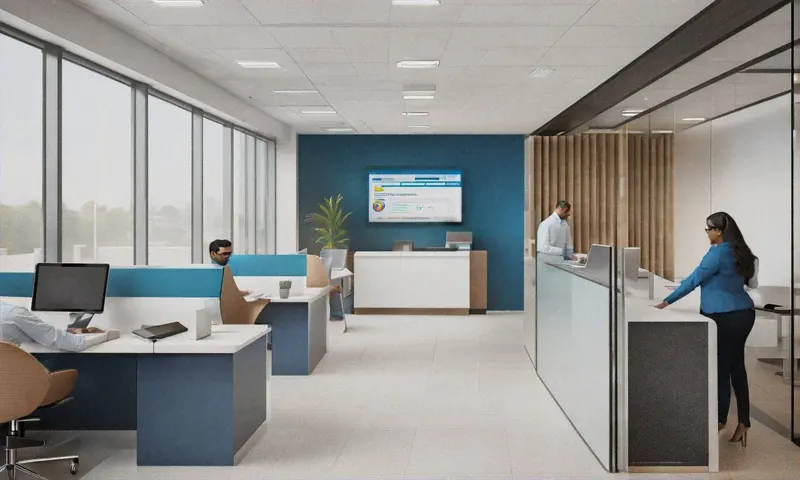
You reach the branch by 9:30 AM. The branch opens at 10 AM. Before opening, there's a quick morning meeting with the Branch Manager -- targets discussed, pending issues raised. Then the shutters go up and customers start coming in. As a PO, your desk might be the loan desk. Farmers come in wanting crop loans. Small businessmen need working capital. A retired teacher wants to know about her fixed deposit interest. You process applications, check documents, assess creditworthiness, sanction eligible loans within your authority, and escalate larger cases to the Branch Manager or the regional office.
Lunch break is technically 30 minutes at 1:30 PM. In practice, you eat at your desk while handling the post-lunch rush. By 3:30-4 PM, the counters close to walk-in customers but the back-office work continues. Voucher passing, account reconciliation, report generation, compliance requirements. You might finish by 5:30 or 6 PM on a normal day. On month-end or quarter-end, expect to stay till 7-8 PM clearing backlogs and generating reports.
Saturdays are working days twice a month (second and fourth Saturdays are off). Bank holidays follow the RBI list, which is different from the central government gazetted holiday list -- you get some holidays that offices don't, but you also work on some days when others are off.
The work is varied. Some days you're processing a MUDRA loan for a chaiwala who wants to expand his stall. Some days you're resolving a dispute about a deceased person's joint account. Some days you're attending a kisan mela (farmer's fair) organized by the district administration, setting up a loan camp. And yes, some days you're just fighting with the software because the core banking system decided to crash at the worst possible time.
Career Progression: From PO to Where?
The career ladder in a PSB is well-defined. And this is honestly one of the best things about banking -- you know exactly where you can go.
You join as Probationary Officer (JMGS-I). After about 2 years of probation, you're confirmed. Then it's promotion time. After roughly 3-4 years as a confirmed officer, you become eligible for Manager (MMGS-II). The promotion process involves a written departmental exam in most banks plus an interview. Some banks have made it largely seniority-based with a minimum performance score. After Manager, you move to Senior Manager (MMGS-III) -- typically after another 4-5 years. Then Chief Manager (SMGS-IV), which usually comes around the 12-15 year mark. Then Assistant General Manager (SMGS-V) -- this is where you oversee an entire region or head a large department.
Above AGM, you have Deputy General Manager, General Manager, Executive Director, and finally Managing Director and CEO. These top positions are filled through a combination of internal promotions and government appointments. The MD/CEO of a public sector bank draws a salary comparable to a Secretary to the Government of India. It's not private sector CEO money, but the position and influence are significant.
Here's something many people don't know: bank officers can be deputed to the Reserve Bank of India, SEBI, NABARD, SIDBI, and even to government ministries. Some officers get posted to the bank's overseas branches -- London, New York, Dubai, Singapore, Hong Kong. A friend of mine who joined PNB as a PO two years before me is currently at the PNB representative office in Dubai. She handles NRI accounts and trade finance. Her life is nothing like what she imagined sitting in the exam hall in Kanpur.
Preparing for the Exam: An Honest Roadmap
If I were starting my IBPS PO preparation today, knowing what I know now, here's exactly what I'd do.
First three weeks: baseline assessment. Take one full-length mock test for Prelims without any preparation. Check your score. See where you stand in each section. If your score is below 30 out of 100, you need 5-6 months of preparation. If it's between 30-50, you need 3-4 months. If it's above 50, you need 2-3 months of focused practice.
For English: read The Hindu or The Indian Express editorial page daily. Not the news, the editorials. They use the kind of vocabulary and sentence structures that appear in bank exams. Note down 5 new words per day with their usage. For grammar, focus on subject-verb agreement, articles, prepositions, tenses, and voice. For reading comprehension, practice reading passages and answering questions without re-reading the passage multiple times -- you don't have time in the exam.
For Quantitative Aptitude: this section is all about speed. You need to be able to do percentage calculations, fraction conversions, and basic arithmetic in your head. Practice with R.S. Aggarwal or Arun Sharma. For DI, the trick is to approximate rather than calculate exact values. If an option says 37.5% and another says 42.3%, you don't need to calculate the exact answer -- approximate and choose. Bank DI questions are designed to be solved through approximation more often than exact calculation.
For Reasoning: this is the make-or-break section in bank exams. Seating arrangement puzzles can take 5-8 minutes each. Practice daily -- one puzzle set in the morning, one in the evening. Start with simple linear arrangements, then move to circular, then double-row, then multi-parameter. Syllogisms, inequalities, and coding can be solved using standard techniques that you can learn from any good YouTube channel or book. Blood relations and direction sense are free marks if you practice them enough.
For General/Banking Awareness (Mains only): follow banking and economy news specifically. RBI monetary policy decisions, repo rate changes, new government schemes, GDP growth data, merger and acquisition news in the banking sector, fintech developments, important appointments in the financial sector. Download a banking awareness capsule from any coaching institute -- most give them free. Learn financial terms: NPA, CASA ratio, SLR, CRR, marginal cost of lending rate, base rate, repo, reverse repo, treasury bills, commercial paper. If you don't understand what these mean, start reading about them now.
Mock tests: take at least 25-30 Prelims mocks and 15-20 Mains mocks before the respective exams. Analyze every single mock. The best candidates I've seen are not the ones who take 100 mocks. They're the ones who take 30 mocks and analyze each one for an hour afterward.
Dates and Fee
Notification: 20 February 2026. Registration opens: 25 February 2026. Registration closes: 18 March 2026. Prelims: May 2026 (exact dates TBA). Mains: July 2026. Interview: September-October 2026. Bank allotment: November 2026.
Fee: 850 rupees for General/OBC/EWS candidates. 175 rupees for SC/ST/PwBD candidates. Payment through online modes: debit card, credit card, net banking, UPI, IMPS, mobile wallets. Once paid, the fee is non-refundable.
The Application: Fill It Carefully
Go to ibps.in. Click on the PO/MT CRP 2026 link. Register if you're a first-time user. Fill in your personal details -- make sure your name, date of birth, and father's name match your documents exactly. Even a missing initial can cause problems at document verification.
You'll be asked for bank preferences. This is where you rank the 11 banks in the order you'd prefer. Think about this seriously. Where does the bank have most branches? Where are you likely to be posted? What's the bank's reputation for work culture? Talk to people who work in these banks if you can. Don't just randomly rank them.
Upload your photo and signature in the specified format. Photo: recent, colour, white background, JPG, 20-50 KB. Signature: on white paper, JPG, 10-20 KB. Get these done at a studio if needed.
What They Don't Tell You About Banking
I want to share some things that no recruitment article or coaching class will tell you, because I think you deserve to know before you invest months of preparation.
First, targets. Banks run on targets. Deposit mobilization targets, loan disbursement targets, CASA targets, insurance cross-selling targets, credit card targets. As a PO, you'll have targets from day one. Some months you'll meet them easily. Some months you'll be calling customers at 6 PM trying to close one more fixed deposit before the deadline. This is the reality of modern PSB banking. It's not a sit-back-and-relax government job. It's a service job with commercial pressures.
Second, transfers. You will be transferred. Every 3-4 years, sometimes sooner. And you don't always get to choose where. A friend was transferred from Pune to a remote block in Chhattisgarh. She adjusted, but it took months. If you have strong roots in one city and can't imagine living anywhere else, think carefully about whether banking is for you. The transfers are part of the deal.
Third, customer interactions can be draining. Most customers are lovely. But some will shout at you because their pension didn't credit on time (which might not be your fault at all). Some will bring political pressure to get loans sanctioned that don't meet criteria. You need patience and a thick skin. If you're someone who takes things personally, this job will test you.
But here's the flip side, and this is why I've stayed in banking for fourteen years. The job satisfaction when you sanction a loan to a small business owner and see their shop grow over the next two years? Unmatched. The respect you get in a rural community as the "bank officer sahab/madam"? Real. The financial security of knowing your salary comes on the 1st of every month, recession or not? Priceless. The travel passes, the medical cover, the housing, the pension -- these add up to a quality of life that many private sector employees earning double your salary don't have.
And the career options. After 5-6 years in banking, you can attempt the RBI Grade B exam for a position at the Reserve Bank. You can apply for deputation to SEBI, NABARD, or government ministries. Some bank officers write the IAS exam and clear it. Your banking experience gives you a perspective on economics, governance, and ground-level implementation that very few other jobs provide.
To Wrap Up
IBPS PO 2026 is your door into public sector banking. It's a career that will give you stability, respectability, and experiences you can't predict. It's also a career that will demand your patience, your adaptability, and your willingness to work in places and conditions you didn't plan for. That's the honest picture.
If that sounds like something you want, register before 18 March 2026 on ibps.in. Start preparing the day you submit your application. And when you're sitting in the exam hall in May, remember -- every bank officer in this country, from the Branch Manager to the Managing Director, sat in that same chair once. They made it through. You can too.
Good luck. I mean that genuinely.
Source: This article is based on the official IBPS CRP PO/MT 2026 notification published on ibps.in. Candidates should visit the official website for the complete notification, bank-wise vacancy details, and any subsequent corrigenda.
Comments 0
Leave a Comment